

East of Collins Expediting · August 2026
Restaurant Permitting Miami · Restaurant Licensing South Florida · Barra Callao · Michelin Bib Gourmand Miami · Restaurant Expansion Permits · North Miami Beach Restaurants
Before the Bib Gourmand: The Permitting Partnership Behind Barra Callao’s Growth
Chef Anthony Verastegui and Carmin Tillit reflect on more than a decade of restaurant openings, difficult locations, business growth, and the professional relationship that helped turn one concept into a lasting culinary legacy.
Recognition can appear to arrive all at once.
A name is announced. A distinction is placed on the door. New guests begin searching for a reservation, and a restaurant that has spent years building its reputation suddenly reaches a wider audience.
But the work behind that moment rarely happens overnight.
For Chef Anthony Verastegui of Barra Callao, the Michelin Guide Bib Gourmand recognition represents years of culinary development, discipline, risk, and persistence. It belongs to Anthony, his family, and the restaurant team that created an intimate Peruvian dining experience people repeatedly return to.
For Carmin Tillit, Vice President of East of Collins Expediting, the recognition also brought back memories of everything that came before it.
The first restaurant. The difficult opening. The licenses, permits, relocations, and new concepts. The moments when Anthony wanted to move faster than the process allowed—and the moments when Carmin had to remind him that opening correctly mattered more than opening recklessly.
Their story is not about a permitting company taking credit for a culinary award. It is about what can happen when a chef and a strategic permitting partner continue building together for more than a decade.
An Important Distinction
Barra Callao earned the Michelin Guide’s Bib Gourmand distinction, recognizing restaurants that pair exceptional cuisine with outstanding value.
A Relationship That Began Before the First Restaurant
Carmin’s connection to Anthony’s family began through their food.
Years before she became involved in Anthony’s first independent restaurant project, she had followed the family’s Peruvian cooking from one location to another. She remembers searching for the restaurants where Anthony’s father was working because the food left a lasting impression.
When Anthony later began preparing to open a concept of his own, Carmin was there to help with the permitting and licensing.
That initial engagement developed into something larger than a transaction.
They were both Peruvian. They understood the cultural significance of the food. More importantly, they shared a belief that the business needed to be built correctly, even when doing so required more time, patience, or difficult conversations.
Over the years, the relationship grew into a combination of professional trust, friendship, and honest accountability.
Anthony describes Carmin as someone who did more than process paperwork. She challenged him when necessary, guided him through unfamiliar decisions, and helped him understand what had to happen before a restaurant could legally and operationally open.
Carmin describes herself, with affection, as his “business mama.”
“A strong permitting partner is not there merely to agree with the client. Sometimes the most valuable thing that partner can say is, ‘Not yet.’”
— East of Collins Expediting
The First Opening—and the Conditions No One Could Ignore
The first restaurant they opened together was not an easy project.
The property came with existing complications that affected the permitting and licensing process. Issues connected to the location had to be identified, understood, and resolved before the restaurant could move forward.
For a chef preparing to open his first business, those conditions were more than administrative inconveniences. Every delay carries financial pressure.
The temptation in that environment is understandable: move as quickly as possible, solve each problem as it appears, and do whatever it takes to open the doors.
But restaurant permitting does not reward improvisation.
Building approvals, fire requirements, occupational licensing, inspections, contractor work, and operational documentation are interconnected. Completing one step out of sequence can delay another. Beginning work without understanding the location’s existing conditions can transform a manageable issue into a much more expensive one.
Carmin’s role was to bring order to that pressure.
The project required persistence, coordination, and a willingness to address the property as it actually existed—not as everyone wished it existed.
Eventually, the restaurant opened.
That first location became successful and developed a loyal following that remained with Anthony for years. More importantly, it became the first proof point in a long-term business journey. The opening was not memorable because everything went smoothly. It was memorable because it did not—and the team still found a responsible path forward.
Restaurant Permitting Is Not Separate From the Business
Restaurant owners often think of permitting as a preliminary task.
Find the location. Submit the documents. Pass the inspections. Open the doors.
In reality, permitting decisions can shape the entire business.
A property’s existing use, utility capacity, kitchen infrastructure, occupancy, exits, fire protection, accessibility, parking, ventilation, grease management, and previous permit history can influence whether a concept is viable in that space.
Those factors can affect:
- The number of seats the restaurant can support
- The equipment that can be installed
- The amount and type of construction required
- The inspections and professional documentation needed
- The project budget
- The realistic opening schedule
A beautiful dining room does not compensate for a location that cannot legally support the intended operation.
A signed lease does not guarantee that the concept can be permitted as designed.
And a contractor beginning work does not mean the correct approvals are in place.
The permitting conversation should begin before the owner becomes emotionally or financially committed to a location. The earlier the site and concept are reviewed, the more options the owner retains.
“Dedicate Yourself to What You Know”
During the interview, Anthony offered one of the clearest lessons from his experience opening multiple restaurants:
“Dedicate yourself to what you know. At the end of the day, delegating the work to professionals saves you money in the long term.”
— Chef Anthony Verastegui, Barra Callao
For a chef, that means the food, the team, the menu, the guest experience, and the financial and operational decisions that only the owner can make.
It does not mean ignoring the permitting process.
It means recognizing when specialized work needs to be delegated to people who understand it.
Anthony acknowledged that new business owners often attempt to manage everything themselves because opening a restaurant is expensive. Avoiding another professional fee can feel like a responsible way to protect the budget.
But the calculation changes when inexperience causes delays, rejected submissions, incorrect construction, or lost operating time.
What appears to save money in the beginning can cost substantially more by the end.
The value of professional permitting support is not that the owner becomes uninvolved. The value is that the owner no longer has to independently interpret every municipal process while also trying to build and launch a restaurant.
There Is a Sequence—and It Matters
One of the recurring tensions in restaurant development is the desire to move faster.
Owners have payroll, rent, vendor commitments, inventory decisions, and investors waiting for the business to open. Every additional day can feel unacceptable.
But moving quickly and moving strategically are not the same thing.
“There is a sequence. There is a way to do things. Let me worry about the paperwork while you worry about the restaurant.”
— Carmin Tillit, Vice President, East of Collins Expediting
That sequence may include reviewing the property, confirming the approved use, identifying existing violations or open permits, finalizing plans, selecting licensed contractors, securing building and trade permits, completing inspections, obtaining the necessary operational licenses, and coordinating final approvals.
The exact path depends on the jurisdiction and the condition of the property.
Trying to bypass the sequence does not eliminate it.
It usually causes the missed step to return later, when correcting it is more disruptive and expensive.
Carmin’s responsibility is therefore not to move at the pace of the client’s anxiety. It is to create the fastest responsible path based on the actual requirements.
That distinction has shaped her relationship with Anthony throughout their years of working together. He brings urgency. She brings sequence. The work moves forward because both are necessary.
From One Concept to a Long-Term Restaurant Partnership
The first opening was not their last project together.
As Anthony’s career developed, the work evolved through different restaurant spaces, concepts, licenses, and operational needs.
Each project brought a different set of conditions.
Some involved moving an existing operation. Others required adapting a new property to the concept. Some created opportunities for growth, while others required the team to resolve inherited challenges before moving forward.
Across those projects, EOC’s role was not simply to repeat the same process.
The Beginning
The First Independent Restaurant
EOC helps Anthony & family navigate the permitting, licensing, property complications, and opening process for his first restaurant concept.
The Growth Years
New Spaces, Concepts, and Licenses
The relationship continues through multiple projects, each requiring a new review of the property, jurisdiction, construction scope, and operational path.
The Current Concept
Barra Callao
Anthony creates an intimate, focused restaurant built around Peruvian seafood, careful presentation, and a strong culinary identity.
The Next Stage
Expansion Into the Adjacent Unit
The availability of the neighboring space creates an opportunity for additional seating, private events, and greater operational flexibility.
The Recognition
Michelin Guide Bib Gourmand
Barra Callao receives a Bib Gourmand, bringing wider recognition to the food, team, and focused restaurant experience Anthony spent years developing.
Restaurant permitting is jurisdiction-specific and property-specific. A successful strategy in one location may not transfer directly to another. The permitting team has to reassess the building, approved use, proposed scope, ownership conditions, municipal requirements, and operational plans each time.
That continuity is one reason long-term professional relationships matter.
After years of working together, Carmin understands how Anthony operates. She knows when he is becoming impatient. She understands the level of quality he expects. She recognizes when a concept is still evolving and when a decision has become firm enough to move into documentation.
Anthony, in turn, understands that Carmin’s caution is not resistance. It is risk management. That trust allows the process to become more direct, even when the project itself is complicated.
Barra Callao: A Small Space With Demand Beyond Its Walls
Barra Callao represents a different stage in Anthony’s career.
The concept is intimate, focused, and closely tied to his culinary identity. Guests experience Peruvian and Japanese influences through seafood, ceviche, causas, and carefully composed dishes prepared with precision.
The space is intentionally small.
But the demand has not remained small.
From early in its run, guests regularly encountered limited seating and waits for a place at the counter. The restaurant’s success created a new operational question:
How could the concept grow without losing what made it work?
Opportunities to expand directly into an adjoining space are not common. Restaurants are often constrained by neighboring tenants, building conditions, lease structures, or the cost of relocating.
In Barra Callao’s case, the adjacent unit became available.
Anthony moved quickly to secure it, creating the possibility of additional seating and greater flexibility for private dining and special events.
Once again, growth brought permitting back into the conversation.
An expansion is not simply a matter of opening a wall and adding tables.
The additional space can affect occupancy, exits, accessibility, fire and life-safety requirements, mechanical and electrical systems, plumbing, construction permits, inspections, and the restaurant’s operational licenses.
The objective is not only to gain square footage. It is to integrate that square footage into the restaurant legally, safely, and in a way that supports the next stage of the business.
What the Michelin Bib Gourmand Recognition Means
In 2026, the Michelin Guide recognized Barra Callao with a Bib Gourmand.
For Barra Callao, the recognition validated something its regular customers already understood: a small, focused restaurant can deliver food of remarkable quality without becoming inaccessible or losing its personality.
The achievement belongs to Anthony and his team.
Permitting did not create the food.
Licensing did not develop the menu.
Municipal approvals did not produce the flavor, consistency, hospitality, or discipline Michelin’s inspectors recognized.
But the restaurant still needed a compliant, operational foundation from which that culinary work could reach the public.
That is where EOC’s contribution sits—not in the award itself, but in helping the business remain capable of opening, operating, adapting, and expanding while Anthony concentrated on the work for which he would ultimately be recognized.
A Restaurant Recognized by Its City
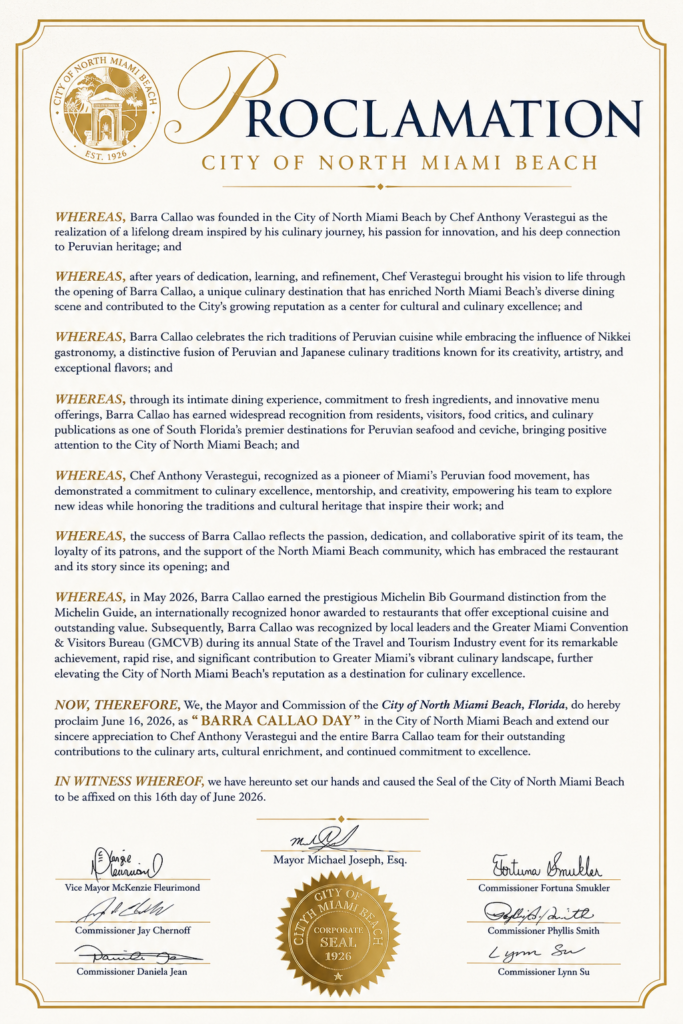
The City of North Miami Beach formally recognized Barra Callao on June 16, 2026.
The Michelin Guide was not the only institution to recognize what Barra Callao had built. On June 16, 2026, the City of North Miami Beach formally honored the restaurant with a proclamation—a milestone now celebrated as Barra Callao Day.
For Anthony and his team, the recognition reflected more than culinary success. It acknowledged the restaurant’s contribution to the city, its culture, and the community that supported its growth.
Why the Recognition Felt Personal to Carmin
When Carmin learned about the Michelin recognition, her reaction was immediate and emotional.
She had seen more than the finished restaurant.
She had seen the difficult first project.
She had watched Anthony and his family navigate periods of momentum and uncertainty.
She had worked beside them through new spaces, different concepts, licensing requirements, property complications, and the pressure that accompanies each opening.
“The pride overwhelmed me. I know the effort they have made, everything they have experienced as a restaurant, as a business, and as a family.”
— Carmin Tillit, Vice President, East of Collins Expediting
The pride she felt was not based on claiming ownership of the achievement.
It came from recognizing the distance between the first set of plans and the Michelin Guide recognition now displayed at Barra Callao.
Long-term client relationships allow you to see that distance clearly.
You remember the restaurant before the guests arrived.
You remember the location before the corrections were completed.
You remember the owner before the market knew the name. And when recognition finally comes, you understand how much unseen work preceded it.
The Work Behind the Work
Customers experience a restaurant through what is visible.
The food. The service. The atmosphere. The energy of the room. The details that make them return.
They rarely see what had to happen before the first plate could be served.
- The property research
- The plan review
- The contractor documentation
- The building and trade permits
- The fire requirements
- The inspections
- The licensing
- The corrections
- The sequence
Those elements alone do not make a restaurant exceptional.
But when they are mishandled, they can prevent an exceptional restaurant from opening at all. That is the work behind the work.
How EOC Approaches Restaurant Projects
East of Collins Expediting does not approach restaurant permitting as a document-delivery service.
We approach it as an operational risk function.
That means understanding the concept, the property, the jurisdiction, the construction scope, and the owner’s intended timeline before building the permitting strategy.
It also means telling clients what they need to hear, not only what they want to hear.
Sometimes the location needs more investigation.
Sometimes the plans are not ready.
Sometimes a contractor needs to provide additional documentation.
Sometimes opening next week is not realistic.
And sometimes the most important contribution a permitting consultant can make is preventing the owner from taking an action that creates a larger problem.
The goal is not delay. The goal is an opening that can withstand scrutiny—and a business positioned to continue operating after the excitement of opening night is over.
When Restaurant Owners Should Bring EOC In
The ideal time to involve a permitting consultant is before signing a lease or finalizing a construction schedule.
That allows the team to evaluate whether the property and concept align before the owner’s leverage disappears.
EOC is also brought in when:
- An existing restaurant is expanding into an adjacent unit
- A concept is relocating
- A property has unresolved permits or violations
- A restaurant is changing ownership or operational structure
- The owner is introducing a new use or service
- Construction has stalled
- Municipal comments are delaying approval
- The opening timeline no longer matches the permitting reality
The later the problem is identified, the fewer options may remain. Early involvement protects flexibility.
Before the Recognition, There Was the Foundation
The Michelin Guide Bib Gourmand recognition may be the most visible chapter in Barra Callao’s story so far.
But it is not the first chapter.
Before the recognition, there was a chef trying to open his first business.
There was a difficult property.
There were permits, licenses, inspections, corrections, relocations, risks, and new ideas.
There was a professional relationship built through honest advice and repeated trust.
And there was a shared understanding that doing things correctly was not separate from building something successful.
It was part of the foundation.
Chef Anthony created the food that earned Barra Callao its Bib Gourmand. East of Collins Expediting is proud to have helped him build the operational path that allowed his work to reach this moment—and to continue supporting the expansion that comes next.
Opening, relocating, or expanding a restaurant in South Florida?
East of Collins Expediting works with chefs, restaurant groups, landlords, contractors, and design teams to manage restaurant permitting and licensing from early property review through final approvals.
Bring us in before the pressure becomes the strategy.
📞 754.423.6283
East of Collins Expediting
Permitting with Precision. Partnership with Purpose.
East of Collins Expediting is a South Florida permitting and expediting firm specializing in restaurant permitting, business licensing, municipal coordination, building and trade permit management, inspections, restaurant expansions, and complex project approvals across Miami-Dade, Broward, and Palm Beach counties.